PART I: The Sangeet
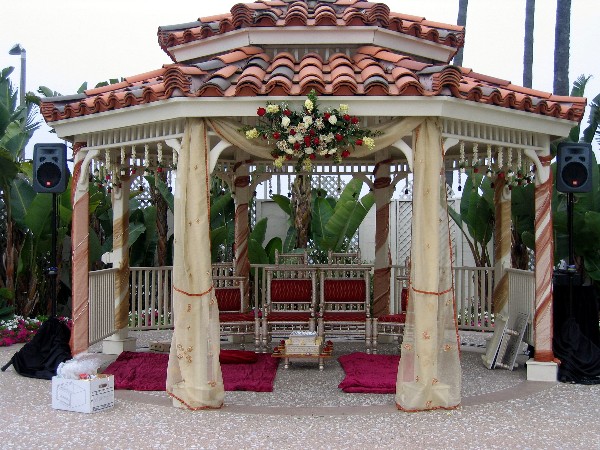
 Amit and Ritu's wedding began with a sangeet, a traditional evening of entertainment that takes place just prior to the day of the wedding. It is a festive night of excess, in which the guests indulged in a wide variety of delectable cuisines while taking in a series of well-rehearsed song and dance numbers by the members of the bride and groom’s artistically talented family.
The sangeet is also important because it is the first point in the Indian wedding where our non-Indian friends incorporate themselves into Indian culture. For weeks up to the wedding, we emphasize to them the importance of maintaining Indian customs and dress during the event. The details can be daunting, but friends like Matt Murphy are good sports and are willing to don a borrowed sherwani for the sake of an old college friend like Amit. It is at this point that Matt truly begins to feel that he is part of the event.
The glow is fleeting as Matt walks into the reception hall only to find that all of the Indians have shown up in suits (I mean, who has time to change into a Sherwani after work?). He realized that he is the object of an old Indian joke (in the same spirit as the time I invited Sean Stallings home to eat traditional Thanksgiving “Curried Turkey” with my family) and must spend the remainder of the evening humiliated as the Indian parents walk around calling him a gaandu.
Ok, maybe that just a depiction of how I thought the night would work out in my head. The reality is that Matt put on that sherwani and instantly became the life of the party. He took on this “Bill Clinton on a state visit to 
Meanwhile, I had the stink of “old news” in the eyes of the Indian guests. Amit would introduce me to an uncle who after a few seconds of evaluating the blue kurta that I had clearly worn previously to a low-level puja, would simply say “nice homespun beta, now go get some Black Label for me and my buddy Mett.”
At least Korok performed admirably for the Bengalis. Having learned from the “shirt-with-embroidered parrot” travesty that he wore to my cousin’s wedding in
Anyway, in all seriousness, I had an amazing time and along with Amit, downed several Red Bulls in order to prep myself for two more full days of action. As a people, I really have to give the Punjabis credit for going all out when it comes to emphasizing the enjoyable aspects of a wedding. Bengalis, by contrast, often have the tendency to intellectualize the fun out of everything. As my mother likes to say, "Bengalis don’t have sangeets largely because we are an understated and introspective lot"... it’s a smart remark when you think about it: it simultaneously enables us to act like snobs (“we prefer to emphasize the pious nature of the occasion”) while tacitly acknowledging that we aren’t inherently a very fun or talented people. This is a classic Bengali trait, one I'm sure will be expounded upon in excruciating detail by Jhumpa Lahiri in her next book.
I can only imagine what a Bengali sangeet would look like: some lackey recites verses from the Rabindra Sangeet as a collection of Bengali men, adorned in drab kurtas that fit awkwardly under a Cosby sweater, sit cross-legged with a glass of Chivas Regal in one hand and a fresh rasgulla in the other. Their eyes closed and heads bobbing left to right ever-so-slightly, they listen silently, with only the occasional “bah, bah” in response to a particularly moving mantra.
I’ve spent many years trying to understand why Punjabis and Bengalis have such different conceptions of fun. The best explanation that I’ve come up with so far is that Punjabis are alcoholics and Bengalis are inveterate stoners.
PART II: The Mehendi and Barat After a final night out with the boys at Y-Bar, I struggled to drag myself out bed to get ready for the barat, an event that has become my favorite part of the Punjabi wedding. Reeling after being upstaged both by Korok and Matt Murphy, I decided to step things up notch by wearing an ultra modern kurta that according to my cousin, had drawn the accolades of the (surprisingly open) gay male Bengali community during my last visit to
 In
My fondness for the barat stems from my cousin’s marriage to a Punjabi in
Against the groom’s will, his family at this point decided that it would be cute for all of them to act like they wouldn’t let him off unless we paid them some amount. Not speaking a word of Hindi or Punjabi, I smiled acceptingly as they spelled out their terms. Apparently unaware of the contrived nature of the situation, the man who owned the horse seemed to be under the impression that all terms of the wedding were really up for renegotiation. Inserting his diminutive frame between the horse and myself, he demanded that we pay him more money before he would let the groom off. Of course, this is where the esteemed members of my extended family (most of whom I had never met before) chose to argue over an extortion fee that amounted to 150 Rupees ($3 US). Having officially lost my patience, I turned the death eyes on to one of my purported uncles and told him (in very American English) to “ pay the man. right…now.” Thus marked the auspicious end to what is the social experiment that is the Punjo-Bengali barat (See sidenote).
Amit and Ritu’s barat was a little more organized and enhanced by the grandeur of the elegant structures that line
A group of people from the street pulled me aside and asked me what was going on. Having not spent my jackass quota for the day, I told them that Amit was the “Nawab of Amritsar” who was in
The end of the barat was followed by a cordial greeting of the families in which the mother of the bride welcomes the groom and the males of the respective families give their respective counterparts a bear hug in which they try to pick one another up. Following a short intersession, I met up with the Bengalis, along with esteemed members of the Contemporary Issues Roundtable and made my way to the massive reception hall where the actually wedding ceremony was to be held.
As great as so many aspects of the barat were, I would by lying to you if I didn’t say that the best part may have been marching past the stunned family and guests of an American wedding that was also being held at the hotel. Though a great feeling of cultural pride set in as we passed by, I have to admit that I couldn’t quite tell whether their jaws dropped to the floor out of jealous awe or simply because they were dumbstruck by the National Geographic Special that was unfolding before their eyes.
Ok, that’s enough for now. Part III is coming soon.
 (Sidenote 1): My sister-in-law Christina likens my cousin's wedding to that of Connie Corleone from the beginning of “The Godfather.” However, unlike that wedding, the hierarchical roles haven’t quite worked themselves out in our family as yet. For example, as Bridezilla, my cousin fit the role of young Connie perfectly, but her elder sister Neelakshi is clearly our family’s matriarch-in-waiting, much like Connie from Godfather III (my mother currently rules our family with an iron fist as Mama Corleone and Christina revels in her role as Kay. I do think she worries about whether I'll bring home Apollonia, but that would call for a footnote-within-a-footnote).
The role of Michael is still up for grabs. After my terse exchange with the uncle, however, Christina declared that I had moved ahead in the race. My brother (knowing that I really want the title) agreed with her and self-deprecatingly fashioned himself as our modern day Fredo. The truth is that his thoughtful, measured, and conflict-avoidant nature is more fitting of a Tom Hagen. It should also be noted that my family also has an embarassment of riches when it comes to filling the role of Fredo. I won’t go into excessive detail about who the Don Vito of our fa mily is, but I will say that it has been a passive struggle between two agressive men (my dad and my uncle, the father of the bride) since my mom’s dad passed away 30 years ago. Both men loom large, but out of paternal loyalty, and the fact that he has a compelling Vito-esque immigrant experience under his belt, I’m going to give the nod to my old man, Big Chakra. (I am also acutely aware of the consequences if he were ever to find out about this blog and read otherwise).


3 comments:
Arjun, I am impressed with the extensive introspection contained within your blog... I think that you are being a bit hard on yourself about your lack of trendy Indian wedding attire. I am sure that you will be able to find a sheik kurta at the next Banana Sale that will catapult you into the spotlight of the next Indian wedding!
Hey now, I've been trying to diversify away from Banana and bought some new stuff from Ben Sherman. However people are telling me that I look like a punk.
The public has spoken.
Ha ha, I love your play on "sheik and chic." I was telling someone at a party that Steve Levitt should follow "Freakonomics" with a book on the geopolitics of oil, called "Sheikhonomics" and follow it up with a book on fads called "Chiconomics."
Post a Comment